11 Pieces Of Kitchen Equipment Worth Owning And 4 You Can Skip
Kitchen equipment marketing is designed to make every gadget feel essential. Most of it is not.
A crowded kitchen with tools you rarely use is harder to cook in than a spare one with things that earn their place every week. These are the items that actually change how you cook, and the ones taking up drawer space that do nothing a simpler tool couldn’t do better.
Worth it: A good chef’s knife

One sharp, well-balanced chef’s knife does more work than a full block of mediocre knives. An 8-inch chef’s knife handles almost every cutting task in a home kitchen: chopping, slicing, mincing, breaking down a chicken, halving a squash.
The quality of the knife matters less than keeping it sharp. A mid-range knife that’s properly maintained outperforms an expensive one that never gets honed.
Buy one good knife, learn to use it well, and sharpen it regularly. The rest of the block can wait.
Worth it: A cast iron skillet

Cast iron retains heat exceptionally well, goes from stovetop to oven without complaint, and with minimal care lasts for generations. A 10-inch or 12-inch skillet handles searing meat, baking cornbread, frying eggs, and finishing dishes under the broiler.
The seasoning builds over time. A well-used cast iron pan performs better than a new one.
It is one of the few kitchen purchases that appreciates with use rather than declining.
Worth it: A digital instant-read thermometer

Guessing whether a piece of meat is done by feel or timing is unnecessary and unreliable. An instant-read thermometer removes the guesswork in seconds.
The difference between a pork loin at 140°F and one at 160°F is the difference between juicy and dry. The difference between a chicken thigh at 165°F and one at 185°F is the difference between safe and overdone.
Bread, candy, and deep-frying all have temperature targets that matter. A decent digital thermometer costs under thirty dollars and pays for itself the first time it saves a roast.
Worth it: A bench scraper

A bench scraper is a flat, rectangular metal blade with a handle along the top. It scrapes dough from a work surface, portions it cleanly, transfers chopped vegetables from a cutting board to a pan without the awkward scoop-and-spill of using the knife blade, and cleans the counter in one pass.
It does several small jobs that are mildly annoying without it and effortless with it. It costs almost nothing, stores flat, and gets used every time you cook.
Worth it: A rimmed half-sheet pan

Sheet pans are underrated as a cooking tool. A heavy, rimmed half-sheet pan, the standard size used in professional kitchens, fits in most home ovens and handles roasting vegetables, baking cookies, toasting breadcrumbs, and finishing proteins under the broiler.
Two of them cover most tasks. The thin, flimsy versions warp in a hot oven.
A heavier gauge pan conducts heat more evenly and doesn’t buckle. It is a workhorse that deserves more credit than it typically gets.
Worth it: A fine-mesh strainer

A fine-mesh strainer rinses grains, strains stocks and sauces, sifts flour and cocoa powder, and drains pasta too small to risk a colander. It does the work of several more specialized tools.
The mesh needs to be fine enough to catch small particles; the cheap versions with wide mesh gaps are less useful. A medium-sized strainer with a long handle that can rest across a bowl is the most practical format.
It earns its place every week in a working kitchen.
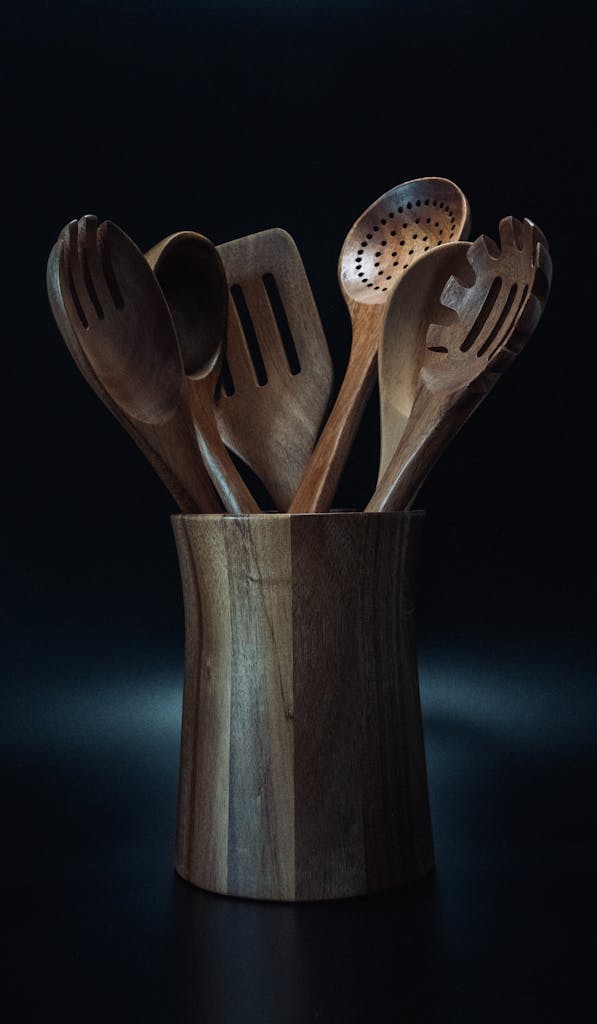
Worth it: A wooden spoon and a silicone spatula

These two tools handle most stirring and scraping tasks. A wooden spoon doesn’t scratch nonstick surfaces, doesn’t conduct heat, and doesn’t react with acidic foods the way metal can.
A flexible silicone spatula gets into corners of pans and bowls that nothing else reaches cleanly. Both are cheap, both last years, and between them they cover most of what a drawer full of plastic utensils attempts to do.
Worth it: A Dutch oven

A heavy enameled Dutch oven braises, soups, stews, bakes bread, and deep-fries. The weight and tight-fitting lid trap moisture and distribute heat evenly in ways that thinner pots don’t.
It goes from stovetop to oven without modification. A 5 to 6 quart size handles most tasks without being impractical to lift.
Quality Dutch ovens are expensive but last decades with basic care. A cheaper version in bare cast iron does most of the same work.
Worth it: A box grater

A four-sided box grater handles cheese, vegetables, citrus zest, and fresh ginger. The large holes grate hard cheeses and shred vegetables.
The small holes produce fine shreds of parmesan or hard cheese that melt quickly and evenly into sauces. The side with small puncture holes, sometimes called a zester on a box grater, removes citrus zest without the pith.
One tool, four surfaces, minimal storage space required.
Worth it: A kitchen scale

Baking without a scale is cooking with imprecise measurements. Volume measurements for flour, sugar, and cocoa vary significantly depending on how the ingredient settles in the measuring cup.
Weight doesn’t vary. A scale is also faster for most tasks: you hold the bowl on the scale and add ingredients directly, weighing as you go, rather than measuring into separate cups and then combining.
An inexpensive digital scale accurate to one gram handles everything a home cook needs.
Worth it: A Y-shaped peeler

The Y-peeler, with its horizontal blade perpendicular to the handle, gives more control and less fatigue than the traditional straight peeler. It works with the natural motion of the hand rather than against it.
Peeling a potato or a large butternut squash with a Y-peeler is noticeably faster and easier. The blade stays sharper longer on quality versions because the angle of contact with the vegetable is more efficient.
Once you switch, the straight peeler stays in the drawer permanently.
Skip: The egg separator

An egg separator is a small cup with slots that catches the yolk while the white drips through. Your hands do this faster, more cleanly, and with no additional equipment to wash.
Crack the egg into your palm, let the white run through your fingers, and transfer the yolk to another bowl. Done in three seconds.
The device exists to solve a problem that a clean hand already solves.
Skip: The avocado slicer

This tool splits, pits, and slices an avocado with a single device. A chef’s knife splits and pits an avocado in two motions, and a spoon or the knife edge slices the flesh.
The avocado slicer does nothing that takes more than fifteen seconds to accomplish with tools already in the kitchen. It is also too wide to pit most avocados cleanly and too bulky to store without noticing it every time you open the drawer.
Skip: The single-use spiralizer

A full-size spiralizer that sits on the counter produces vegetable noodles. It is large, has multiple parts to wash, and does one thing.
A julienne peeler does a similar job in less space. If zucchini noodles are a regular part of your cooking, a compact hand-held spiralizer accomplishes the same task at a tenth of the size.
The counter-mounted version is bought with enthusiasm and moves to the back of a cabinet within six months in most kitchens.
Skip: The electric can opener

A good manual can opener costs three dollars and works indefinitely. It takes ten seconds to use and has one part.
The electric version takes up counter space or drawer space, requires a power source, and does the same job on a slower timeline. The only use case that justifies an electric can opener is a mobility limitation that makes manual use difficult.
Otherwise, it is solving a non-problem.
The actual principle

Equipment earns its place by doing something that nothing else does, or by doing something so frequently that having the right tool changes the experience of cooking. Everything else is a solution waiting for a problem that isn’t coming.